


Brothers and Sisters,
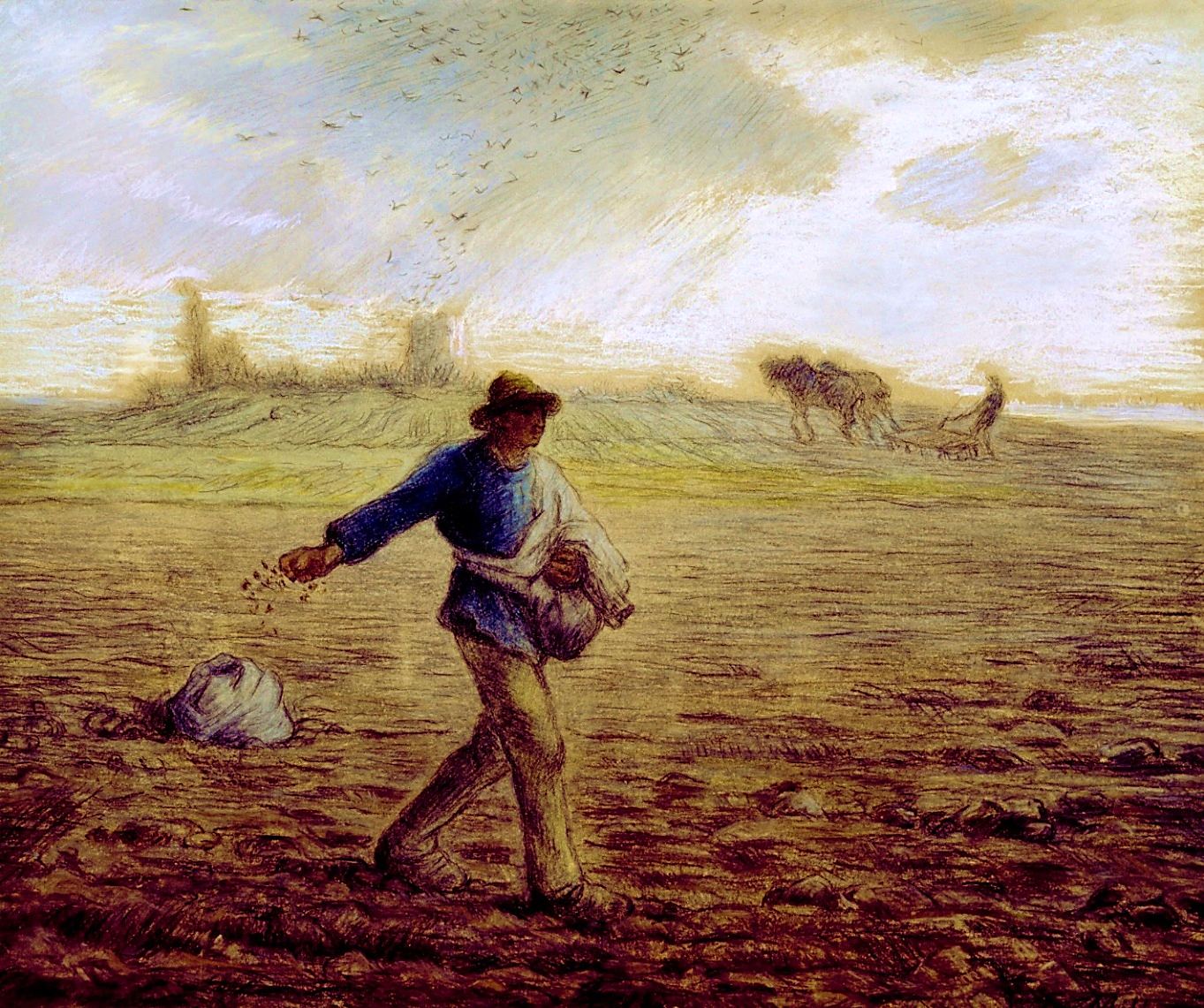
Parables are stories that make a point and teach a lesson. The illustrations can be humorous and even farfetched, but their purpose is to prove a point and make us think. Jesus is a master storyteller. He uses parables that capture moments of everyday life to speak to the heart of the listener giving images that are at the same time familiar and new.
In the parable of the Sower and the seed Jesus used a very familiar image from everyday life, the image of the farmer planting his crops. Jesus was not the first to use parables. It was actually a common method for teaching amongst Rabbis of his day. However, Jesus excels in his use of imagery that stays with the listener. Even 2000 years later, his parables are alive with life and the lessons are applicable to our modern world.
In the first part of the text Jesus goes out to teach the people. The crowds were so large that he climbs into a boat and begins to teach from the shoreline. He shares with his disciples the parable of the Sower and the seed. The metaphor he uses here makes more sense when we look back a few paragraphs preceding the parable. Jesus had a run in with the pharisees and the scribes who asked him for a sign to prove who he was. They addressed him as ‘Teacher’, showing their lack of faith in him. This behavior is not shocking when we look at it in the greater context of the gospel, but as Jesus uses the parable it is clear that the metaphor is referring to the differences between his disciples and those who were opposed to him. Knowledge of the Kingdom, he states, is granted to those who open their hearts and hear and see who Jesus is. To those whose hearts are closed they neither see, nor understand and so in the end even the little that they have will be taken away.
I have a friend his name is Tom. Tom is an American success story. Life was not always easy for him growing up. He had some learning disabilities that seemed to hold him back as a child, but he never gave up. Tom worked hard and over time found his niche. He sold his first company in his early twenties and parlayed that into a role as a managing partner in a firm that was eventually taken over by a fortune 100 company. As always, Tom managed to find himself on top. Not long after his ascension we were at a gathering together and I had the opportunity in a quiet moment to chat with him. Like many people I was surprised by his tremendous success. Tom, however remained the same humble nice guy I always knew him to be. In chatting with him I asked him the secret to winding up on top. Being in a reflective mood, Tom pointed to one thing. He said he learned to listen. He said that as a child his head was so filled with distractions, he had trouble focusing and this caused him a lot of problems. Later on in life when he was in college and playing football he was sidelined after an injury and risked losing his scholarship. In order to keep it, he had to improve his grades. It was then that he met a tutor who would change his life. This tutor not only helped him with his course work but taught him how to truly focus his brain and listen for the first time. Tom never forgot the lesson of listening and learned instead to use it to his advantage, and it served him well in the business world. While everyone was clamoring to be heard, he sat back and listened. It was by listening that he learned that there were places in the banking industry that needed innovation and he built a business out of it. When other bigger banks were looking to expand and found his innovations useful, he listened for the right partnership. When a fortune 100 company was looking for banks to add to their portfolio that were growing and stable, he listened and helped his new firm position itself for a new partnership. Tom listened. And it wasn’t just a matter of hearing what was said or was needed, he responded to position himself and his company to succeed.
Tom’s success was in part based on luck. He was in the right place at the right time. But as lucky as he has been, I think that his ability to listen and be open to the possibilities turned his luck into achievement.
In the gospel Jesus praises those who have eyes to see and ears to hear. The difference between his followers and the scribes and pharisees is not that they are smarter or more capable, but simply that they are open to receive his word and believe. For the pharisees and scribes, their hearts are so hardened that they miss the opportunity to meet God in their midst. Because they do not listen and hear the Lord’s voice calling to them, they will be excluded from the Kingdom.
In a world full of people screaming to be heard, who is listening and truly hearing? Am I listening to the most important voice; Jesus? I invite you today to stop and listen carefully to Lord. Where is he calling you? He is there, waiting to be heard. Speak Lord, your servant is listening.
Peace,
Fr. Steve