

Dear Brothers and Sisters,
Happy Feast of Pentecost to each of you!
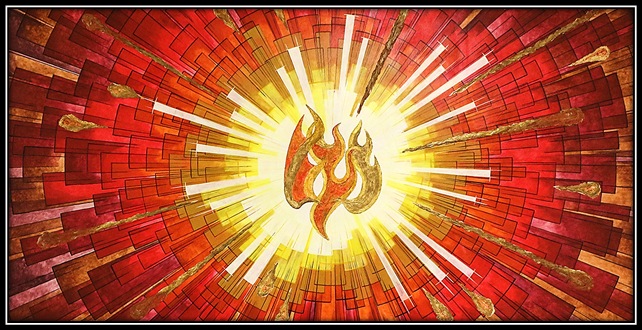
This weekend I have the great honor to confer the Sacrament of Confirmation on several adults from our community. What a joy to be able to share this gift with these adults and to celebrate the gift of the Holy Spirit given to the Church and to each of us! Congratulations to each of them and to their families! Come, Holy Spirit! Enkindle in us the FIRE of your love and renew the face of the earth!
This day our gospel passage takes us back to the Upper Room once again, behind locked doors with the Apostles in shock, and wracked with grief and fear. Mary Magdalene has come to them and astounded them with the wondrous news that she has seen the risen Lord, but they just can’t believe her.
Note the time of day. John tells us it is evening. Mary went to the tomb just before dawn, in darkness. As always light plays a very powerful symbolic role in John’s gospel. Darkness represents unbelief, ignorance, and sin. Those who fail to put their faith in Jesus are stumbling around in the dark. The darkness is a place of fear. Mary started in darkness going to the tomb, but as the sun rose, she began to see the light in her encounter with Jesus. Once enlightened she runs to share the news. Now in the upper room we are told it is dark again and the door to the place where the Apostles are is bolted shut. The disciples are frightened. They fail to see the light. They locked the door in an attempt to keep the darkness at bay. But it is into this dark hiding place that Jesus comes unbidden shattering all their fears.
Notice Jesus first words to his disciples? Not words of condemnation, but a word of forgiveness. Here the risen Christ stands in their midst and his first act is one of reconciliation! The disciples are incredulous with joy. And now he doubles down by further showing them his hands and his side. It is not an act of aggression – as if to say, ‘Look at what you let happen to me!’, but it is an act of proof. As if to say, ‘Look, see, it is really I!’ The glorified body of the Lord is the same body that was crucified, but now transformed. It is obvious that Jesus does not see his wounds as a means of evil, but of forgiveness and as St. Thomas Aquinas would later refer to them as the victor’s ‘trophies’ of battle. The risen Jesus doesn’t need his wounds, but wears them with pride as if to say, ‘See what I did for you!’ They are in a sense our self-worth or value as if to say, ‘I love you this much’.
Next Jesus breathes on them. This is important. If we go back to the very beginning in Genesis, we are told that God’s breath or ‘ruah’ (Genesis 2:7), brought life to creation. Here Jesus breathes new life into the disciples. These men cowering in the dark behind locked doors are spiritually resuscitated. This is John’s representation of Pentecost. As the disciples receive the Holy Spirit, Jesus also draws them into his Mission and makes them envoys of being sent to carry out his work in the world. This new gift is the divine assistance they need to leave the darkness behind. He gives them divine instruction, ‘whose sins you forgive are forgiven them, and whose sins you retain are retained.’ Jesus the Lamb of God who takes away the sin of the world now incorporates his disciples into that mission and gives them the divine power of forgiveness and God’s mercy. The disciples, now filled with new life begin the work of sharing the good news and like Mary Magdalene, they are sent out to fearlessly proclaim the Lord’s gift of redemption.
Today as we celebrate the Solemnity of Pentecost how can we describe the gift of the Holy Spirit who is always with us and in us and filling the Church? Some would like to think of the Holy Spirit as something like the ‘Force’ from the Star Wars movies. But there is a substantial flaw in that thinking. The Force is not personal. It does not make a distinction about good or evil, it is not personal, it is not love – that is -willing the good. No, the Force is more like water or any element. It has to be shaped by the one who uses it. The Holy Spirit, however, is something altogether different. The third person of the Holy Trinity is GOD. This Spirit is the intelligent power of love that emanates from the Father and the Son. The Holy Spirit is personal and relational – seeking to bring about the good that God the Father and God the Son will for the world and for each of us. That is no mindless supernatural force. The Holy Spirit is life giving and active. We do not shape it – IT SHAPES US! Think of the Apostles in that upper room, mourning in shock and grief, filled with fear. Jesus comes to them, the glorified Lord and breathes on them sharing with them the Holy Spirit. From that moment on they are changed. No longer fearful, hiding from the world, but now filled with new life, courageous, fearless!
My friends this is the gift we celebrate today. A gift we too share in from our baptism and our Confirmation. A gift the Church revels in, in our sacramental life. A generous gift given by the Lord to strengthen us to be his people and share in his mission to bring new life to the world. We, like the Apostles are given this gift and invited into the life of God to share in his work. In spite of our faults, failures and at times, unworthiness, this gift is ours. All we have to do is ask to be set alight to let that Spirit burn within us. Oh, what a difference there could be in the world if each of us owned and lived that the gift that we have already been given. If we let it shape and form us into the people God calls us to be. Unfortunately, we don’t see ourselves in that light. We can’t quite believe that God would want us to be his partners – and yet he does! And he has given the Spirit to each of us in abundance. All we have to do is ask him to help us use it. And trust me he will - if we ask!
Blessed Pentecost,
Fr. Steve
