


Dear Brothers and Sisters,
As we enter into the latter part of our Lenten journey the Church gives us the story of Lazarus to reflect on. If you have noticed the Gospels have been rife with ‘signs’ of Jesus power throughout these past few weeks and today will come to culmination with the raising of Lazarus from the dead as we prepare to enter into the story of Jesus Passion.
The scene opens with Jesus receiving word that his friend Lazarus is ill. John goes to great pains to make sure that we know who Lazarus is and how close he is to the Lord. He also gives us the location where his family lives. Bethany is a small village just to the southeast of Jerusalem. In the synoptic gospels, (Matthew, Mark, and Luke) it is reported that Jesus stays at their home when he is in Judea. John further reports that Mary is the one who anoints Jesus’ feet with oil and dries them with her hair. A messenger is sent by the sisters to let Jesus know that Lazarus is seriously ill. Jesus, aware that Lazarus’ illness is part of the divine plan, tarry’s two more days where he is rather than rushing off to cure Lazarus. Lazarus’ death will be a moment of the revelation of Jesus’ divine glory that he truly is the Son of God and the master of life and death.
Jesus remains where he is for two days and then announces that he will return to Judea because of the need to see Lazarus. The disciples, for their part are horrified. They know that danger lurks there for Jesus. But Jesus is undeterred. He uses a colloquial figure of speech about the hours of the day and walking in light and darkness. On a deeper level this saying becomes self-referential. Jesus is the Light of the world. With his light within, no person can stumble. He announces that he must go to Judea for Lazarus, that he is ‘asleep’. The disciples misunderstand and think that the sleep that Lazarus is experiencing is good and healing, however, Jesus is speaking from his prophetic knowledge, but now speaks clearly that Lazarus has died. With Lazarus’ passing Jesus will have the opportunity to manifest his glory and bring others to belief in him. Thomas, believing that this moment may lead to Jesus’ death speaks to his brother’s words of encouragement urging them to follow Jesus even if it means certain death for them as well.
Our next scene opens with Jesus arriving in Bethany, in Judean territory only to find that Lazarus has already been laid in the tomb four days now. As he nears the tomb, we are told that as in accordance with Jewish custom the sisters of Lazarus had been home mourning and being cared for by their friends and relatives, but hearing that Jesus is near, Martha, leaves her mourning behind and goes out to meet Jesus. Martha shows a complex array of emotions. She is in some ways angry, (‘Lord, if you had been here, my brother would not have died.’). There is a tone of accusation here. She and Mary had sent a messenger and yet Jesus did not come. However, in the next sentence she admits that she believes that Jesus is the Lord who has the power to heal, ‘Even now I know that whatever you ask of God, God will give you.’ We get a sense of the conflicting emotions of one who has lost a loved one.
Jesus, for his part makes the pronouncement that Lazarus will rise. Martha misconstrues Jesus’ meaning here. She thinks that he is referring to the belief that there will be a resurrection of the dead at the end of time. Here Jesus makes his fifth proclamation in the gospel of John. He states, ‘I am –‘, in this case, ‘the resurrection and the life’. Through baptism into his life, those who believe in him will never die, but be raised through him to eternal life. He is the source of all life with the Father and the Spirit. He now turns to Martha, and like the man born blind, he asks for the gift of her faith: ‘Do you believe this?’ In essence does she believe that he is the Messiah, the Son of God, doing the works of the Father and not just a prophet or healer? Martha responds with a confession, “Yes Lord. I have come to believe that you are the Messiah, the Son of God, the one who is coming into the world.” Even with an immature faith Martha is able to place her trust in him. This is the true miracle in this scene. The raising of Lazarus is a sign amongst the many miracles that Jesus performs, however faith in the midst of her sadness and trust in the midst of her mourning is the true marvel.
Our Scene shifts as now Martha sends word to her sister that the Lord has arrived. Mary who has been at home observing the mourning custom, gets up immediately and heads to where Jesus is outside the village. Her greeting to the Lord is similar to her sister’s, grief has overcome them both. Martha had sent word to her sister secretly because of the custom of friends and neighbors who gathered at the house to console them. Seeing Mary get up and leave, they follow in pursuit thinking that she has gone to the tomb to weep. Instead, they witness the encounter between Mary and Jesus. Their response to the encounter shows their lack of faith.
Here John shows a different side to Jesus. The interaction with Martha and Mary who are obviously grief stricken, the lack of faith from the crowd now gathering around them, Jesus is moved to deep emotions. We are told two things. First, John tells us that Jesus is ‘perturbed and deeply troubled’. There is a sense of anxiety and upset. The same words are used later in the gospel to describe how he feels at his announcement to his disciples that one of them will betray him and again as he prepares to face his own death praying in the garden. His reaction is to the ultimate battle he is engaging in and the enemy that must be conquered: death. Jesus is angry at death which causes such pain to the ones he loves.
Jesus asks where Lazarus has been laid and so they take him to his tomb. On the way John tells us the second important fact, Jesus so moved by the emotions around him, weeps. He feels their emotional pain.
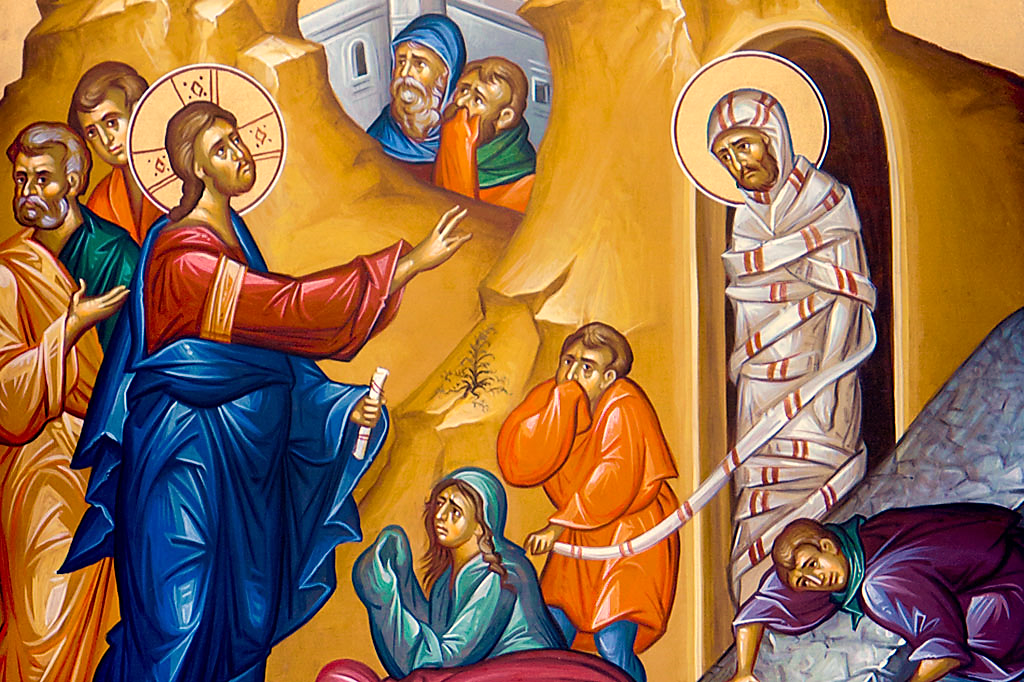
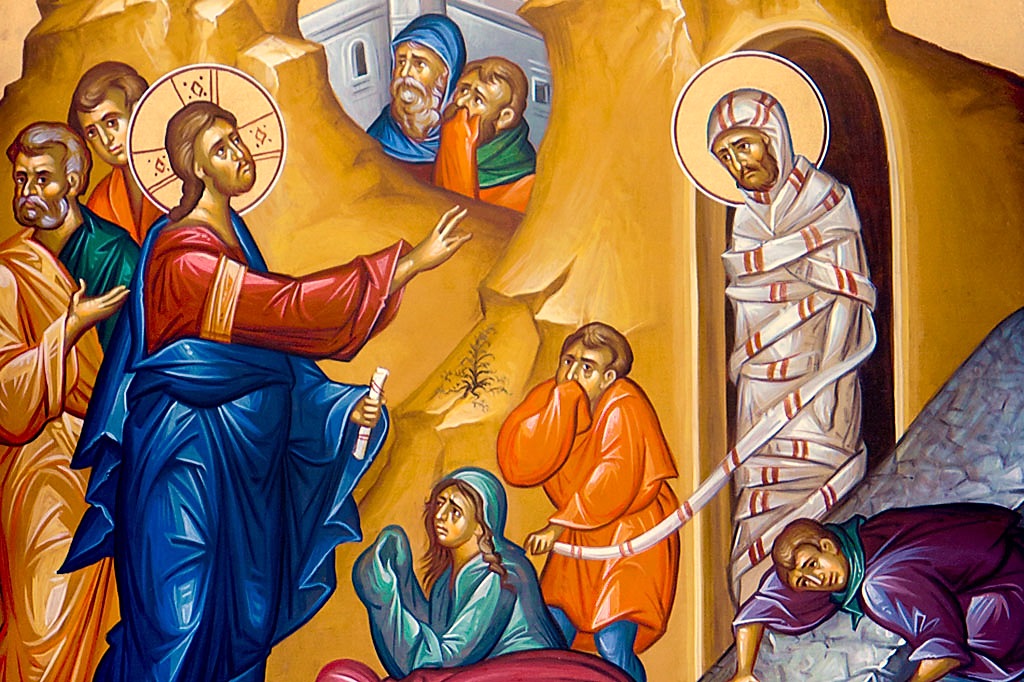
Finally, they arrive at the tomb, and he commands the stone to be taken away. Martha, always the practical one, protests that in removing the stone, there will be a ‘stench’. Her brother already dead four days will have begun to decompose. This points to the truth of Lazarus’ death and the fact that no one will be able to revive him. However, this moment will not end in horror, but life. Jesus is as he stated the ‘resurrection and the life’. He has the divine power to restore Lazarus to life. He will transform Lazarus’ death into a sign of divine glory that will lead others to the Father. It is faith in Jesus that will give people the spiritual sight to see and believe this truth. The workers remove the stone and in an intimate moment we are invited into Jesus’ prayer to the Father. It is a prayer that reveals that he shares the same divine power as the Father. They are united as one. He then calls out to Lazarus to come out of the tomb. The dead man responding to Jesus’ call comes out tied hands and feet in burial cloths. With that Jesus gives the command to untie him and set him free. This is not a resurrection, but a restoration. Jesus brings Lazarus back to life, but not a glorified life – as Jesus would have after the resurrection. Lazarus is raised and restored to mortal life. Lazarus is bound to die again. Those who are resurrected share in God’s glory and will never die again. As Paul states, ‘Christ, raised form the dead, dies no more; death has no power over him (Rom. 6:9).
Probably the most difficult reality that any of us must face is the death of a loved one, or even in some cases our own ultimate demise. Love binds us together and death severs those bonds. Someone we love is no longer with us. But the challenge of our faith and the reality that Jesus calls us too is that death, for those who believe and trust in him, is not the end, but a new beginning. And not just a restoration, as we see with Lazarus, to the earthly existence we see with Lazarus, but a new and glorified life with God. What does it look like? What do we experience? I can’t say. No one can. But for those who believe it is a sacred promise. That if we are faithful to the Lord Jesus, death too, will ultimately have no power over us. For he who has been raised has conquered it for us. For unbelievers, this is nonsense. Something told to the simple to make them feel better, but for people of faith, it is our hope in the midst of the darkest of times and the answer to the most difficult reality.
Next week we begin Holy Week, the culmination of our Lenten fast. Jesus himself will begin his passion. A passion that will lead to his own suffering and death, but ultimately to his rising. A sign to each of us of hope that is everlasting. But it takes an act of faith and trust on our part. That if we unite our moments of suffering and passion to his, he will bring us to rise with him to live forever in his presence.
Peace,
Fr. Steve