


Dear Brothers and Sisters,
For the next three weeks of Lent our Sunday gospels focus on what it means to have faith in Jesus. This week we focus on the Samaritan woman whom Jesus meets at the well.
First, a word about Samaritans. Jews and Samaritans had a long history of animosity that stemmed from a rather tumultuous period in the history of Israel. Samaria takes up a large swath of Palestine sandwiched between Galilee in the north and Judea in the south. In the history of Israel, the Kingdom was split into two when the northern tribes broke away from the south. The northern kingdom was then conquered by the Assyrians. As was typical of those days the conquering Assyrians deported the Jewish elite and replaced them with foreigners who would work the land and be loyal to the Assyrian king. As these people intermarried with the Jews who were left behind the intermingling of foreign cultures and religions had a negative impact on the relationship of the Jews in the south in their relationship with their brothers in the north. The Jews in the north who worshipped the God of Israel did so in a different fashion from their southern neighbors and chief among their differences was their belief that God’s temple was not in Jerusalem as tradition held, but on Mount Gerizim. To the Jews in the south, they saw the Samaritans not as fellow Jews but as Jewish imposters whose faith was tinged by paganism. These differences set up an on-going antagonism and animosity that sometimes overflowed into violence and even war. For the most part, however, there existed between these two groups an uneasy and tumultuous peace.
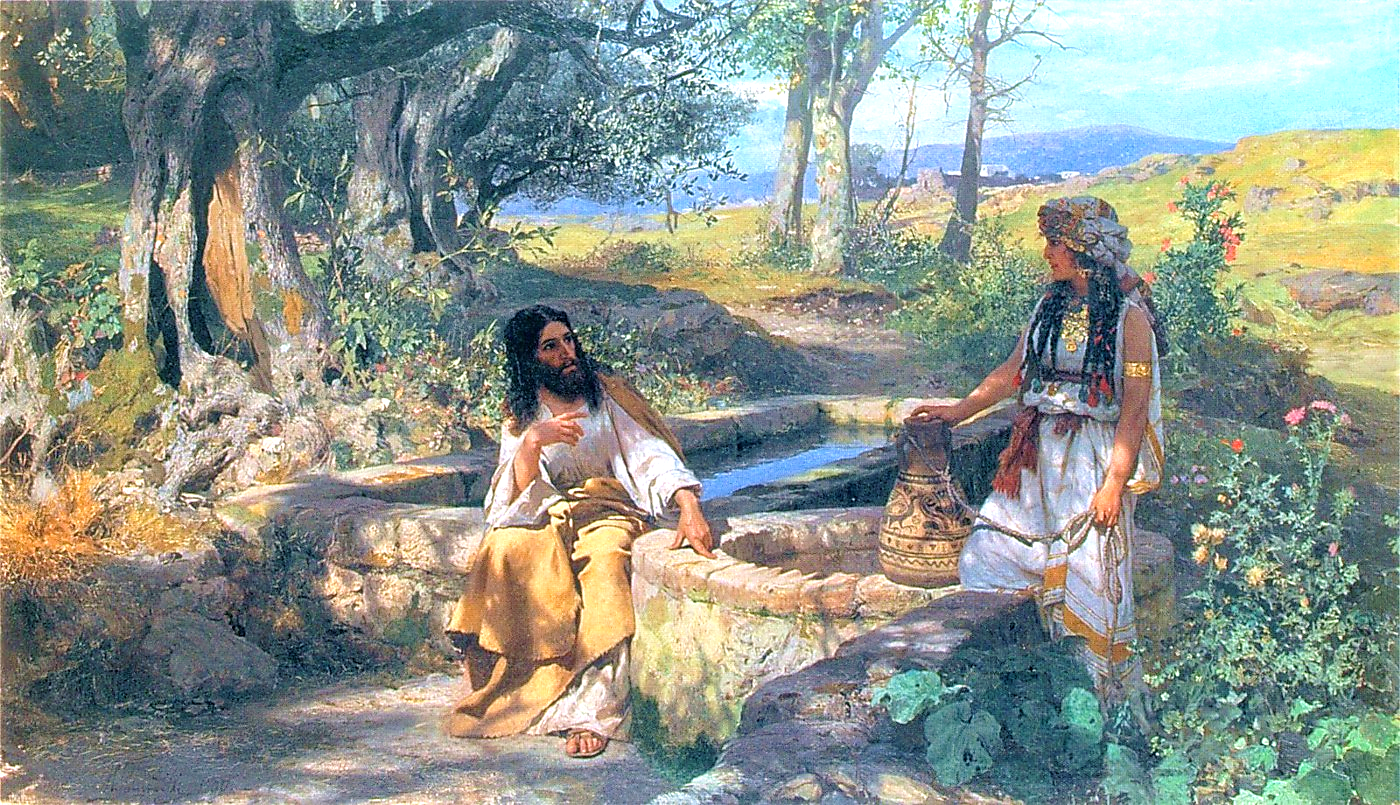
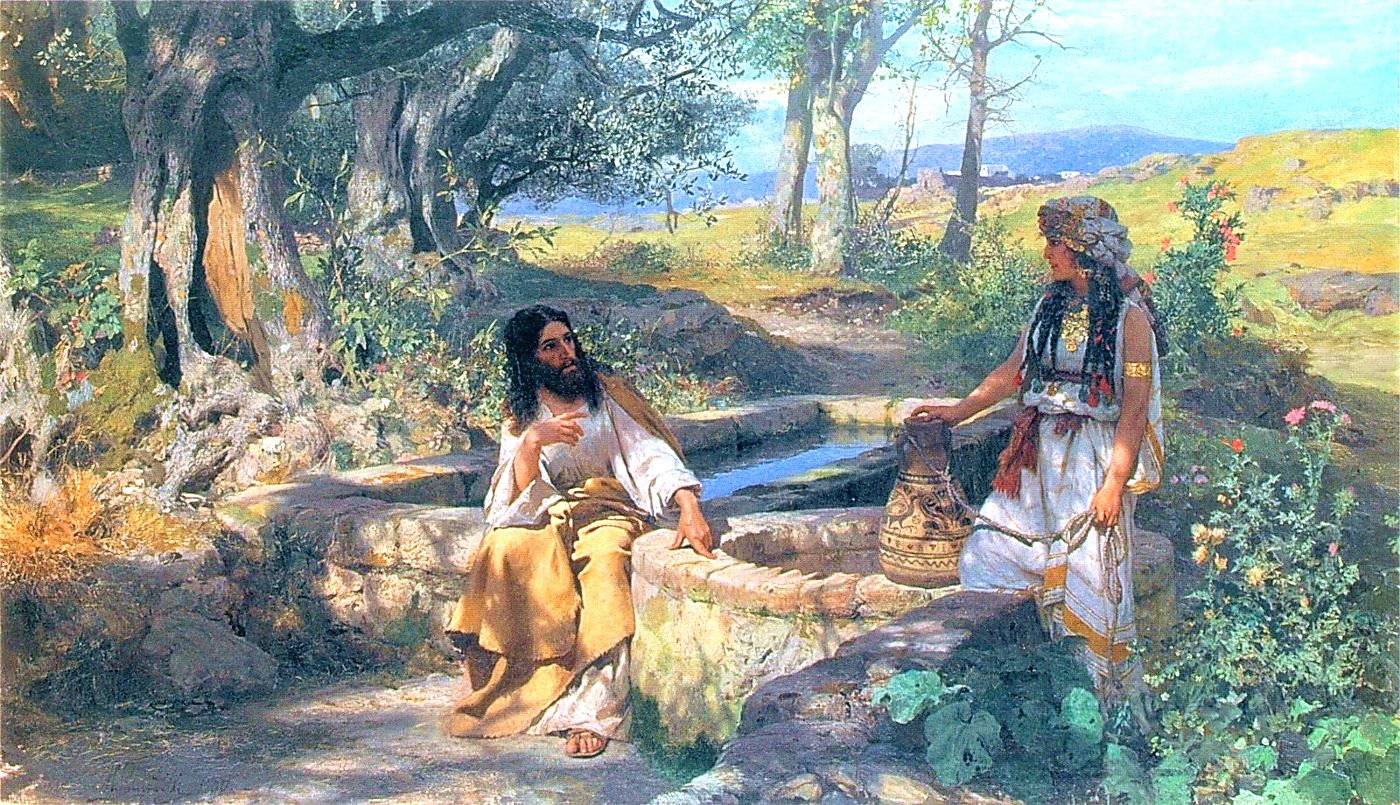
Enter Jesus, traveling through Samaritan territory when he comes to the village of Sychar, about a mile north of the Patriarch, Jacob’s well. Jesus, exhausted from the journey sits down to rest and is thirsty. Significant here is the time and place. John tells us that the location is beside the well. Wells in the Old Testament were places of encounter. Several of the Patriarchs met their spouses beside a well. The time of day is significant too, in that no one comes in the heat of the day to fetch water when the sun is high. Remember water was not a readily available commodity and clean water often had to be collected and brought some distance to the home. It is here and at this time of day that Jesus has an encounter with the Samaritan woman. So why was she doing this at the wrong time of the day? What or who was she avoiding? Also, she comes unaccompanied. Custom dictated that women had to be accompanied, either by other women or by a male relative for safety and the protection of her reputation. The latter is the issue for this woman, hence her desire to come to the well alone and to not meet up with anyone.
So, she is a woman with a clouded past and difficult present. She comes to the well and Jesus does the unthinkable. He initiates a conversation with her and asks her for a drink of water. In the custom of the day a man would not have a direct conversation with a woman who is not his kin. Beyond that, he is a Jew, and she is a Samaritan. Purity and dietary laws for Jews would exclude accepting a drink from a woman, let alone someone deemed an enemy. The result would be by Jewish belief that they would be rendered ‘unclean’ and excluded from Temple worship till they had the matter rectified. But this is Jesus, the law of God embodied. The conversation that begins with a request quickly moves from a literal request for water to a spiritual conversation and the thirst within the woman’s soul. He speaks of ‘living water’ which will eternally quench her thirst, but Jesus himself is thirsty but not for water, but for her faith and belief in him. He thirsts to give her living water – the gift of the Holy Spirit, who quenches the soul and leads us to eternal life. The woman’s immediate response here is confusion. The term ‘living water’ is also an idiom for running water. John is famous here for framing his gospel with many such misunderstandings as those around Jesus think in solely earthly terms while Jesus speaks to them on a higher spiritual plain. The woman’s response is at first very practical and based on her very human perception of the situation. She asks Jesus about his lack of a bucket. How can a man without even a bucket give her running water, when he can’t even get a simple drink of water from such a deep well? She then questions Jesus about his identity. She asks, “Are you greater than our Father Jacob, who gave us this cistern and drank from it himself with is children and with his flocks?” In the original Greek in which the gospel is written this is phrased in such a way that the woman already expected that Jesus would answer ‘no’ to her question. The irony here is that the woman does indeed have greater than Jacob sitting before her. He is the very Son of God.
Jesus for his response to her probes deeper attempting to get her to think differently. He first clarifies that he is not speaking of physical water but contrasting the two. He makes it clear that the water he is offering her is not physical water, but a deeper spiritual one that will fill the soul as natural water never will. This water – the Holy Spirit, will give her divine life lifting her above this earthly realm. The woman for her part realizes that what is being offered to her is different from the water of Jacob’s well, however she still is thinking in earthly terms. She is thirsty, but still not understanding. She asks for this water so that again in practical terms she will not have to keep coming back to draw water. While the woman misunderstands and is still thinking in literal terms there appears to be a spark growing inside her awakening the gift that Jesus is offering her as something completely different.
Now the conversation will take a definite turn as Jesus invites her to go and collect her husband. He already is aware that the man she is living with is not her husband. That indeed she has had five husbands prior to the man she is presently living with. Some scholars have made the assumption that given the location of the well in Samaritan territory and the tenuous relationship between Jews and Samaritans, that the five previous husbands of this woman represents the mixing of pagan communities with their own Gods with the Jews who lived in the territory under the Assyrians. The allusion here is that Jesus not only thirsts for this woman’s faith but that of all of her kinsmen.
There are no misunderstandings here as the woman now recognizes that Jesus is truly someone sent by God. It is reflected on a more meaningful level as she now addresses him as ‘Sir’. Seeing him as a prophet she asks a deeper question regarding one of the more controversial issues between Jews and Samaritans: where the true Temple to worship God is located – Jerusalem or Mt. Gerizim? Remember this is a rather loaded question. But Jesus, in typical fashion rather than simply answering her question reveals a deeper reality. The fact that, ‘the hour is coming’ when true worship of the Father will take place in a totally new way. Here he clarifies the fact that Samaritans do not have the same relationship with the Father that the Jews have, since they are not the chosen people. As a Jew himself, Jesus is not only one of the chosen people, but as a son of Abraham a direct sign of the fulfillment of the covenant made with Israel. It is now Jesus who will bridge the gap between the Father and his lost children. Jesus challenges her on a deeper level to worship in ‘Spirit and truth’. As Jesus previously explained to Nicodemus that one must be ‘born of water and spirit’ (baptism), so too, now Jesus challenges this woman to worship him - who is the ‘truth’ – God revealed. This worship is not only a spiritual one, but one that is materially grounded in the sacraments he reveals to his disciples, (baptism, eucharist, etc.).
The fact that this woman is coming to faith in Jesus is evidenced by her relating her belief in him of her people. The Samaritans believed in the ‘Taheb’, a messianic figure who like Moses, who would be the authoritative figure sent by God to bring salvation to their people. Jesus reveals himself as that Messiah. In the Greek, he states, ‘I am he’ – or ‘I am’ or in ‘ego eimi’ (Grk.), a reference to the name God identifies himself to Moses with as he encounters God in the burning bush in the Book of Exodus.
With that revelation the disciples return with provisions and are shocked to find that Jesus was alone and speaking to a woman who was not a family member. The Samaritan woman departs leaving her water jar at the well and quickly heads into town suddenly filled with zeal. Notice how emboldened she has become. She who was afraid to go to the well while others were around, now seeks out others to bring to the Lord. She relates her encounter with Jesus and then invites them to come and see for themselves with the possibility that he may be the Messiah. Here she testifies to her own experience of Jesus’ prophetic knowledge. Curious, the town heeds her testimony and goes out to seek Jesus out.
Meanwhile the disciples are preoccupied with making sure Jesus eats. When Jesus responds that, ‘I have food to eat which you do not know.” they misunderstand and take him at his word. They wonder who has fed him. He explains, “My food is to do the will of the one who sent me and to finish his work.” In winning over the Samaritan woman and her town Jesus is fed by their faith in him. Jesus continues with a proverb on the on the coming harvest, but the emphasis here is on the urgency of the moment regardless of who planted the seed of faith for the hour is almost at hand.
The scene shifts again as the townspeople led by the woman Jesus met earlier and whose testimony has intrigued them to come and see for themselves. They invite Jesus to come and stay with them which he accepts so that they can experience for themselves Jesus, the savior of the world.
As you and I enter more deeply into the season of Lent, we listen to the story of Jesus’ encounter with the Samaritan Woman at the Well. We would do well to consider how we thirst for the Lord. We who have known him, how do we share the Good News we have heard with others? Do we let the living well of faith in Jesus, water the dry places in our lives? Do we share the gift we have received of living water with others, inviting them to come and see.
Peace,
Fr. Steve