

Dear Brothers and Sisters,
Happy Lent! Yes, ‘Happy’. Here we are at another opportunity to renew ourselves. Any opportunity to be renewed, to become a better version of ourselves’ should be a cause for joy. So… happy Lent! I pray we each will take full advantage of this moment to make of ourselves a wonderful gift to God.
Just a reminder to you about our Lenten observances. Please see the flyers in this bulletin regarding days of fasting for the season of Lent and the flyer with some of the many opportunities available to you from our parish to help you deepen your experience of the season and prepare you for Easter. It is my prayer that we walk together through this holy season that we arise renewed, a better version of ourselves and a truly wonderful gift to give back to God.
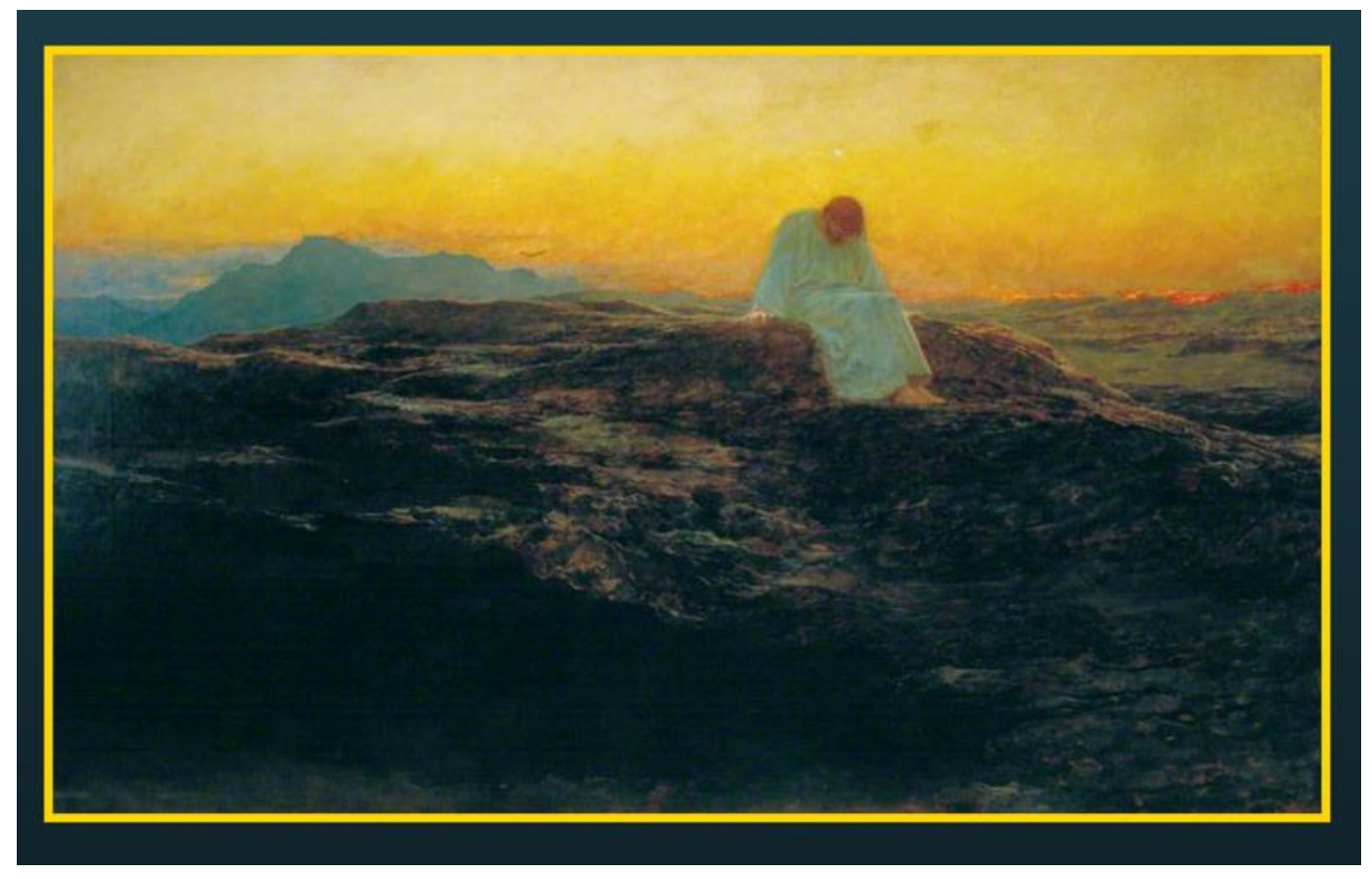
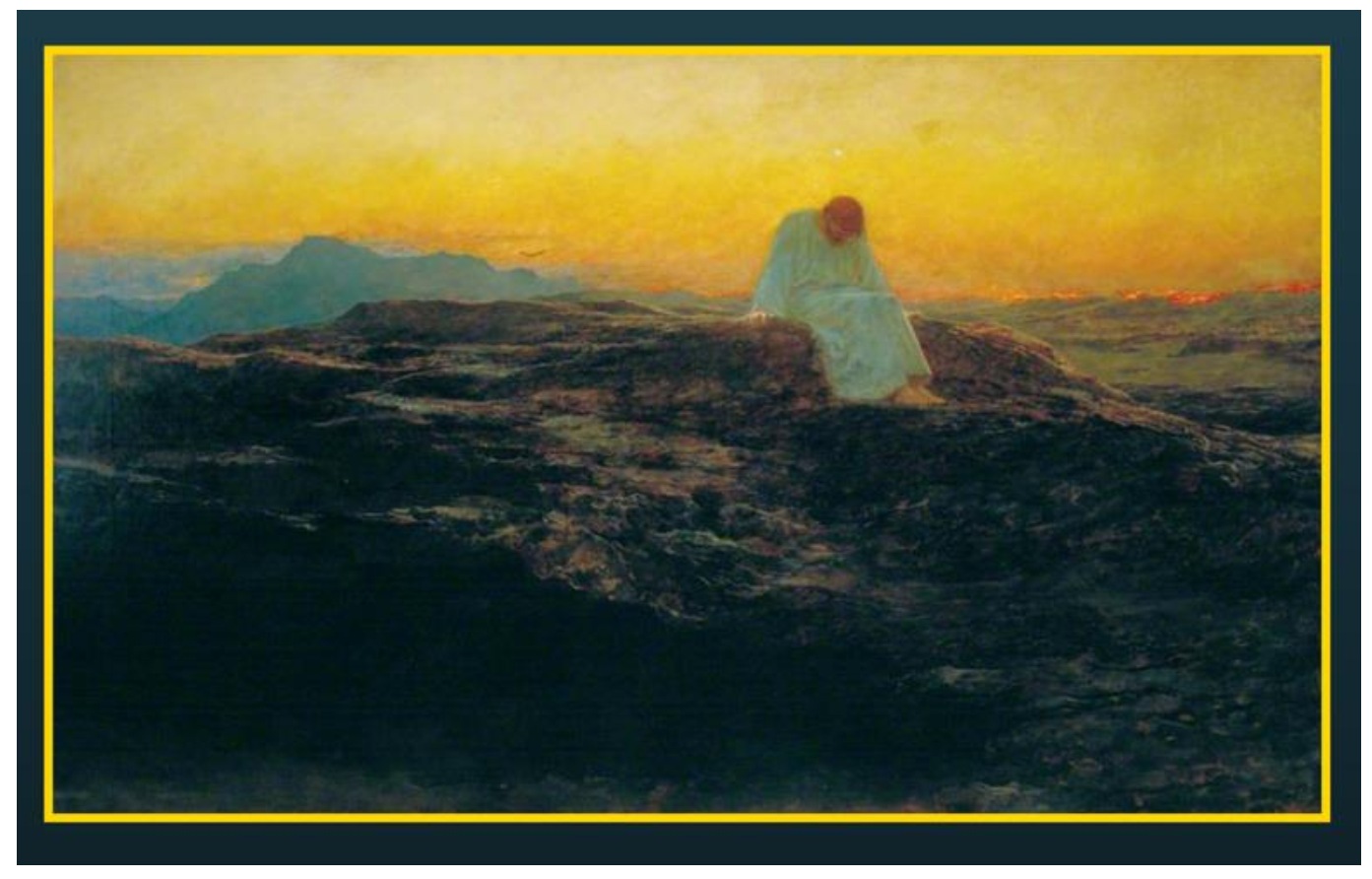
Our Gospel for this 1st Sunday of Lent sets quite a dramatic scene. It starts with Jesus being, ‘driven by the Spirit into the desert to be tempted by the devil.’ Jesus is driven into the wasteland west of the Dead Sea. In ancient thought the desert was not simply a harsh place where only the toughest things could survive. It was a place where they believed evil lurked. There amidst the sand littered with dead flora and animal bones life hung in the balance. Here the Spirit draws Jesus to be tested, but not to be bested. He will emerge truly the Son of God whose word banishes evil and reveals the Father’s hand at work.
The gospel passage begins with Jesus fasting for forty days and forty nights. Here he faces loneliness, deprivation, and hunger. It is here, where even the strongest man will falter, he faces his nemesis, the devil. Matthew presents the temptations that ensue as gradually increasing in intensity. He starts with Jesus most immediate, yet subtle need, food. After fasting for so long, he is hungry. The devil for his part tempts the Son of God to perform a miracle to satiate his hunger. On the outside it may appear to us as a temptation to gluttony. By creating bread out of stones, something Jesus easily could have done, he could have more than his fill, however this temptation is not truly about gluttony or even hunger. The devil is actually trying to tempt Jesus to use his power as God’s Son for his own personal benefit. The bread and the hunger are only a bait and switch to trick Jesus into using this power, a power that could corrupt the strongest man if used wrongly, to assert his own will over that of the Father. However, Jesus’ mission is not one of doing his own will, but that of the Father to reconcile all things. Jesus responds by quoting the Book of Deuteronomy (8:3), “One does not live by bread alone, but by every word that comes from the mouth of God.” In essence, our physical needs are not our greatest needs. Instead, the word of God is our most important food and obedience to that word should be our first priority. Jesus chooses God the Father’s will first, before himself. Jesus resists and so the devil ups the ante.
The next temptation has the devil whisking Jesus off and taking him to the pinnacle of the Temple in Jerusalem. Here the devil tempts him by saying, “If you are the Son of God, throw yourself down.” Again, the devil’s attack is one aimed at the divine Sonship of Jesus and sly as the tempter is, he tries to use the scriptures that Jesus just quoted in his first response against him. His second attempt is a twisting of scripture of a sorts. The devil quotes Psalm 91:11-12 in which God promises to save and protect the honorable man should he stumble by the protection of his angels. The location here is significant as well. Surely there were places throughout the Judean desert where the Devil could have brought Jesus that were much higher or more treacherous, but the Temple in Jerusalem is significant as the place where the God of Israel chose to dwell amongst his people. Here the devil is challenging God’s trustworthiness. It is this very same behavior we will see exhibited by the Pharisees as they constantly seek ‘signs’ from Jesus later in the gospel. Here the devil challenges Jesus to certify God’s promises by making the leap from the Temple to force God to prove that he will be there to support him. Jesus again, quotes Deuteronomy, (6:16), “You shall not put the Lord your God to the test.” The history behind this quotation by Jesus is where the Israelites, after wandering in the desert, begin to grumble against God. Failing to trust God they began to test God for proof of his presence. Jesus naturally resists the devils second attempt.
Finally, the devil tempts Jesus with the strongest corrupting experience yet. He whisks him now to a high mountain peak where the view of the world below is staggering. Now the devil reveals his true hand. From this vantage point he shows Jesus all the kingdoms of the world. His evil motivation revealed – worship of him over that of the Father is finally made clear. He states as he shows him all of the wonders of the ancient world, “All these I shall give to you, if you prostrate yourself and worship me.” Finally, the devil has revealed his true desire and nature. His goal is to get Jesus to make an act of rebellion and worship a false god. He seeks to have Jesus revolt against the divine plan and take a shortcut to the glory to be revealed. By this Jesus would avert embracing the suffering and torment to come. But Jesus is true to the Father in ways the devil could never understand, and he resists this final temptation choosing God’s will over the devil’s temptations. He drives the devil away, “Get away Satan!” and quotes Deuteronomy (6:13) one last time, “The Lord, your God, shall you worship and him alone shall you serve.” With that he makes it clear he will not have any part in Satan’s false enticements.
Jesus has refused to serve himself and choose his will over the Father’s. He has refused to test the Father as a sign of a lack of Trust in the Father’s plan and finally, he has refused to seek glory and earthly power for himself and idolatry in worshipping the devil rather than the Father. In the end Jesus has proven his loyalty to the Father. None of the devil’s false promises are able to deter him or lure him into rejecting the divine plan. The final scene is that of Angels who came and ministered to him. This most likely means that they came to provide him with food, and is an allusion to Elijah the prophet who was fed by the angels (1 Kings 19:4-7).
Our gospel sets us with some important questions as we begin Lent. Jesus doesn’t just conquer the devil’s temptations as the Son of God by divine will. No, here his human will is engaged as well. As St. Paul says in Hebrews 2:18, while tempted he overcame so that he might be a source of strength and consolation to others. Jesus faces off with the devil not just for his own battle, but ultimately a battle for each of us and his victory is a victory for us as well. It was not just the divine Son of God that beat the devil, but the Son of Mary, whose human will overcame temptation to show us the way. As we begin our Lenten journey, may each of us enter our own desert and face our temptations. However, let us remember as scary as that desert is and as strong as those temptations may be, we never go it alone. He who fought the devil and won is with us, armed with the Spirit and loved by the Father, we should never be afraid, but with confidence face our demons to be victorious.
Happy Lent,
Fr. Steve
A Reflection on Lenten Fasting
— by Rev. Daniel Merz
In the early Church and, to a lesser extent still today, there were two fasts. There was the "total fast" that preceded all major feasts or sacramental events. The ancient name for this fast was "statio" from the verb "sto, stare" to stand watch, on guard or in vigil. The second fast was a fast of abstinence from certain foods, e.g., meats or fats. This was more an act of self-discipline and self-control. The statio fast was total and a means of watching and waiting…i.e. for something. The fast of abstinence was more general and personal, to help oneself be more disciplined or self-controlled. The total fast is still kept today prior to reception of Holy Communion. Following Holy Communion, the total fast ceases because Jesus had explicitly stated that we don't fast when the bridegroom is here, in other words, what we're keeping vigil for has arrived, the wait is over. On the other hand, the fast of abstinence was allowed on Sundays because the continuity of abstinence can be important for it to be effective.
These initial observations, then, teach us that the Eucharist is always the end of a preparation. It is always the fulfillment of an expectation. In the Orthodox Church during Lent, they have Eucharist only on Saturday and Sunday. But because Wednesdays and Fridays are total fast days, those two days are also days for the Communion service (Liturgy of the PreSanctified) which are held in the evening, i.e., after the day of preparation. Fasting is always preparatory.
But how did fasting become such an important means of preparing for the Eucharist and of learning virtue through self-discipline? Christian fasting is revealed in an interdependence between two events in the Bible: the "breaking of the fast" by Adam and Eve; and the "keeping of the fast" by Christ at the beginning of his ministry.
Humanity's "Fall" away from God and into sin began with eating. God had proclaimed a fast from the fruit of only one tree, the tree of knowledge of good and evil (Gen. 2:17), and Adam and Eve broke it. Fasting is here connected with the very mystery of life and death, of salvation and damnation. Food perpetuates life in this physical world, which is subject to decay and death. But God "created no death." (Wis. 1:13) Humanity, in Adam and Eve, rejected a life dependent on God alone for one that was dependent rather on "bread alone." (Dt. 8:3; Mt. 4:4; Lk. 4:4) The whole world was given to man as a kind of food, as a means to life, but "life" is meant as communion with God, not as food. ("Their god is their belly." Phil. 3:19) The tragedy is not so much that Adam ate food, but that he ate the food for its own sake, "apart" from God and to be independent of Him. Believing that food had life in itself and thus he could be "like God." And he put his faith in food. This kind of existence seems to be built on the principle that man does indeed live "by bread alone."
Christ, however, is the new Adam. At the beginning of his ministry in the Gospel of Matthew, we read, "When He had fasted 40 days and 40 nights, He became hungry." Hunger is that state in which we realize our dependence on something else—when we face the ultimate question: "on what does my life depend?" Satan tempted both Adam and Christ, saying: Eat, for your hunger is proof that you depend entirely on food, that your life is in food. Adam believed and ate. Christ said, "Man does NOT live by bread alone." (Mt. 4:4; Lk. 4:4) This liberates us from total dependence on food, on matter, on the world. Thus, for the Christian, fasting is the only means by which man recovers his true spiritual nature.In order for fasting to be effective, then, the spirit must be a part of it. Christian fasting is not concerned with losing weight. It is a matter of prayer and the spirit. And because of that, because it is truly a place of the spirit, true fasting may well lead to temptation, and weakness and doubt and irritation.In other words, it will be a real fight between good and evil, and very likely we shall fail many times in these battles. But the very discovery of the Christian life as "fight" and "effort" is an essential aspect of fasting.
Christian tradition can name at least seven reasons for fasting:
a. From the beginning, God commanded some fasting, and sin entered into the world because Adam and Eve broke the fast.
b. For the Christian, fasting is ultimately about fasting from sin.
c. Fasting reveals our dependence on God and not the resources of this world.
d. Fasting is an ancient way of preparing for the Eucharist—the truest of foods.
e. Fasting is preparation for baptism (and all the sacraments)—for the reception of grace.
f. Fasting is a means of saving resources to give to the poor.
i. Fasting is a means of self-discipline, chastity, and the restraining of the appetites.
This article draws in part on the writings of Alexander Schmemann, "Notes in Liturgical Theology," St. Vladimir's Seminary Quarterly, Vol. 3, No. 1, Winter 1959, pp. 2-9. Rev. Daniel Merz is a former Associate Director of the USCCB Divine Worship office.